The Xiaomi Redmi Watch 6 Active cannot record a running route independently because Xiaomi omitted onboard GPS. Anyone who wants route data must carry a smartphone, according to Frandroid’s product and deal report. That omission defines the product more clearly than its catalogue of sports and health functions.
The watch is designed as a lightweight wrist display and activity companion rather than a standalone location device. For commercial teams considering an inexpensive wearable for staff already carrying company phones, that distinction determines whether the product fits the intended routine.
The checkout code does not change the trade-off
Entering the R6A12 promotional code at Joybuy reduces the reported price from €49.99 to €37.99, according to Frandroid. The publication also presents the missing GPS as a concession associated with keeping the watch below €50 at its usual price and below €40 during the offer.
A discount makes the existing specification cheaper; it does not close the gap between wrist-based activity tracking and independent route recording. The relevant purchasing question is therefore not simply whether the reduced price looks attractive. It is whether every intended user already carries a suitable smartphone during the activities that need location data.
The source provides no evidence about bulk purchasing, central device administration, business support or integration with workforce software. This is a consumer-device offer, not a documented fleet deployment. An SME assessing multiple units would need to treat those operational requirements separately from the advertised hardware features.
Thin hardware is built for quick glances
Xiaomi has used a flat case measuring 9.9 millimetres thick and weighing 26 grams. Frandroid also identifies a 1.85-inch AMOLED panel with peak brightness of 1,200 nits, describing it as readable in direct sunlight even though it does not match the strongest displays on the market. These specifications appear in the same product report.
The watch has one physical button and an always-on display that can show the time or notifications without requiring the user to wake the screen, according to Frandroid. That combination supports a specific type of use: consulting brief information from the wrist while the paired phone remains in a pocket or bag.
This does not establish that every business application can send useful notifications to the watch. The report does not document application compatibility, notification controls or how much message content appears. Buyers should therefore separate the confirmed presence of wrist notifications from any unverified workflow integration.
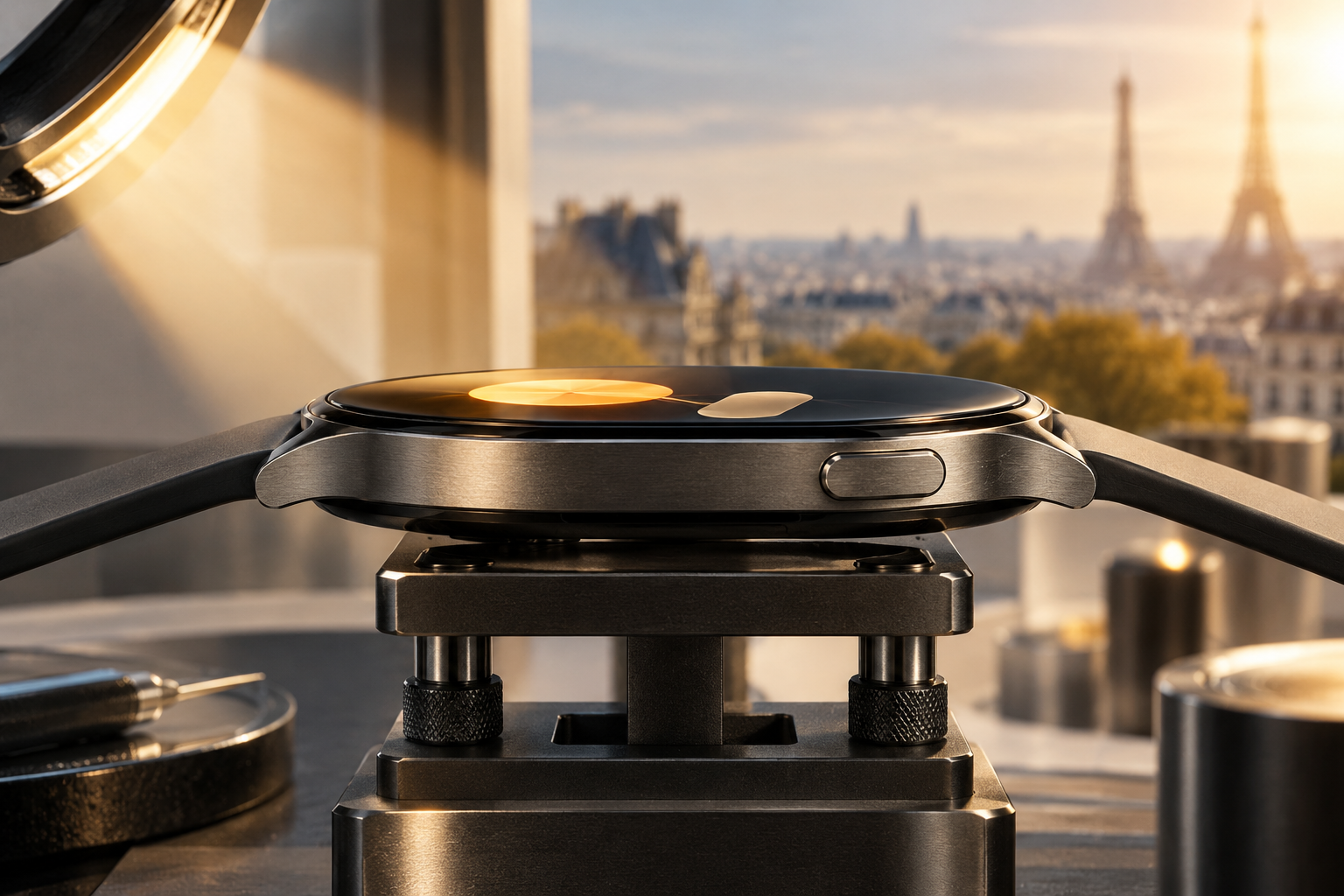
Conceptual illustration of the watch’s thin case and glanceable outdoor display.
Sports breadth does not replace onboard location
The watch offers more than 140 sports modes, including cycling and golf. It also includes stress monitoring, breathing exercises and sleep tracking, as detailed by Frandroid.
An activity mode and a location receiver solve different problems. A mode identifies the type of exercise being recorded, while GPS supplies the changing geographical positions needed to reconstruct a route. Adding more activity categories therefore does not compensate for the absent location hardware.
Consider a hypothetical travelling sales representative who already keeps a smartphone nearby throughout the day. The watch would preserve access to its reported notification and activity functions, while the phone would supply location tracking during a mapped run. For a user whose objective is to exercise without carrying a phone, the same product would not meet the route-recording requirement described by the source.
The report does not provide measured evidence for route accuracy when the phone is present, sensor accuracy, sleep analysis quality or the behaviour of individual sports modes. The large catalogue should be read as feature availability, not as proof that every mode has been independently validated.
Battery claims depend on how the watch is used
Xiaomi claims up to 18 days of battery life under periodic use and around ten days under daily use, figures relayed by Frandroid. They are manufacturer claims rather than results from a documented endurance test in the cited article.
The distinction between periodic and daily use matters because the watch includes an always-on screen, notifications and continuous-wear functions. The source does not specify the precise settings, notification volume or tracking behaviour behind either battery scenario, so the figures cannot establish endurance for a particular employee routine.
The purchasing decision is narrow: choose this watch when lightweight wrist access and basic activity functions matter, the user already carries a smartphone, and phone-dependent routes are acceptable. If phone-free location tracking is the requirement, the missing GPS is a demonstrated product limit that the discount cannot offset.

Conceptual illustration of battery endurance changing with the pattern of use.