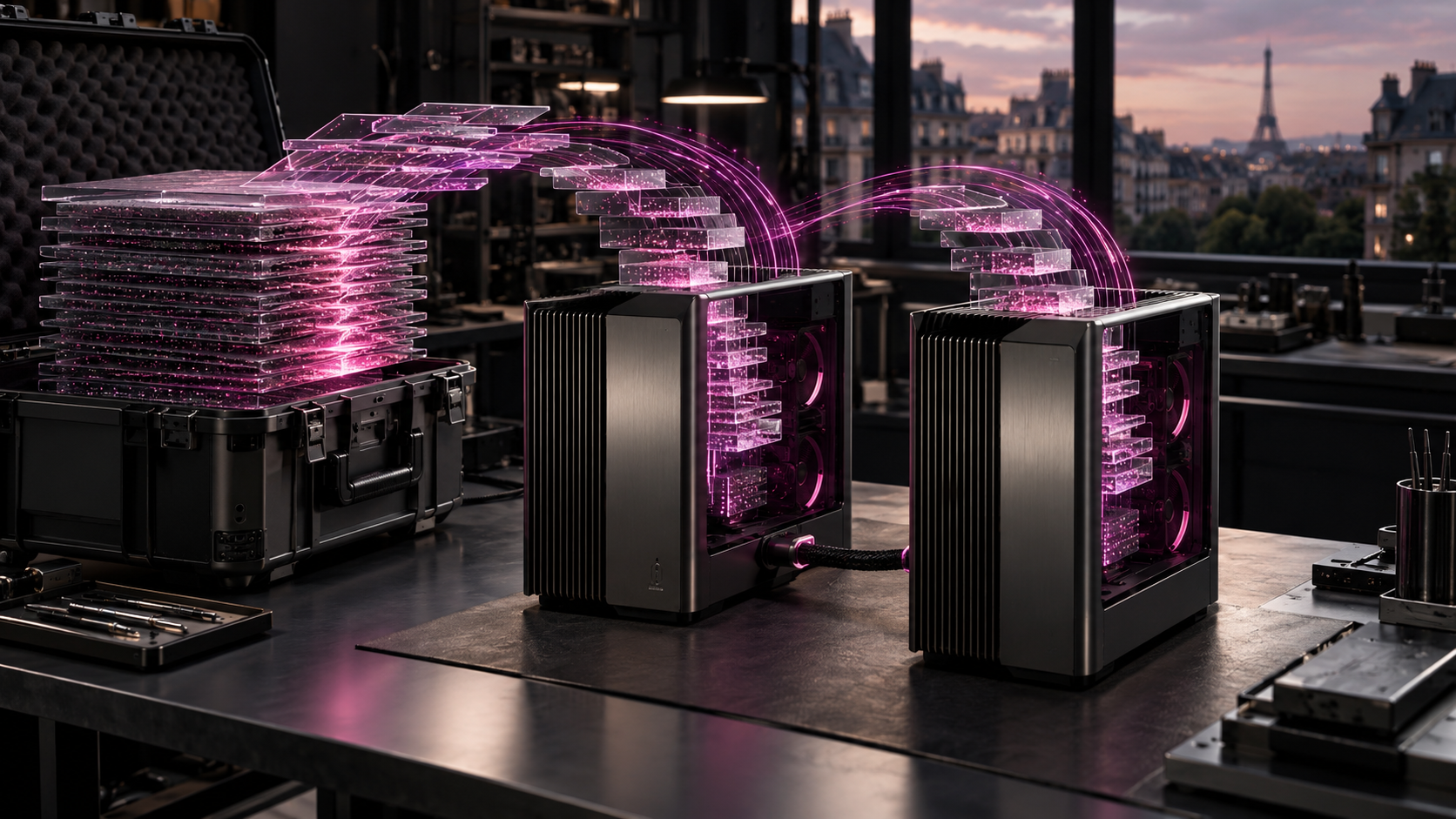
Meta has published the weights for Muse Spark Open, allowing the model to run without sending requests through Meta’s servers. The reported desktop configuration is not a standard laptop or single workstation: it uses two Mac Studio machines linked together, according to Frandroid’s account of the release.
For an SME assessing local AI for recurring work on commercially sensitive material, that distinction changes the decision. Muse Spark Open offers control over where inference runs, but only through a demanding hardware arrangement whose operational performance has not yet been documented in the supplied reporting.
Meta released weights rather than a hosted product
Publishing model weights gives organisations the components needed to download and operate the model on their own equipment. It does not, by itself, provide the managed interface, support, monitoring or maintenance associated with a hosted business application.
Meta describes Muse Spark Open as an open-weight model with 816 billion parameters and says it is the strongest US model in that category so far. The same Frandroid report notes Meta’s claim that a model of this class had not previously run on a desktop computer. Those statements describe scale and deployment format, not performance on sales analysis, proposal drafting or other commercial tasks.
The distinction matters when comparing procurement options. A team is not choosing between two equivalent interfaces. It is choosing whether to assemble and operate a local model environment or consume a closed model as an externally managed service.
Local execution depends on a paired Mac setup
The configuration described by Meta uses two Mac Studio M5 Ultra systems connected through Thunderbolt. Each machine carries 512 GB of unified memory, and the deployment uses MLX, Apple’s open-source framework designed around memory shared by the processor and graphics components, as detailed by Frandroid.
This is the mechanism behind the desktop claim: substantial unified memory, a connection between the machines and software adapted to Apple silicon. The source does not explain how the model is divided between the systems, how long setup takes or what inference speed users receive under sustained workloads.
Meta and Apple worked together for several months to optimise Muse models for Mac hardware, Meta AI lead Alexandr Wang told Axios, as relayed in the same report. Neither company announced a commercial agreement, so the collaboration should not be read as evidence of a packaged enterprise offering.

Conceptual illustration of the unified-memory mechanism supporting local model execution.
Open Spark and closed Wonder serve different decisions
Meta has not presented Muse Spark Open as its best model. Wang acknowledged that the released weights do not represent the company’s most capable systems, while Muse Wonder remains Meta’s more advanced closed model, according to Frandroid.
The practical dividing criterion is therefore not openness alone. Local Spark is the relevant option when operating downloaded weights on owned equipment is itself a requirement and the organisation can support the specified environment. A closed service remains the more direct comparison when the priority is access to Meta’s higher-end model rather than local execution.
For a commercial operations team, the evaluation should begin with one defined workload, such as processing a recurring collection of internal account documents. The release provides no evidence about output quality for that task, supported context, integration effort or throughput. Model size cannot substitute for those missing observations.

Conceptual illustration of the deployment choice between local open weights and a closed model service.
Waiting is justified when the workflow evidence is absent
An SME has a reason to wait if it would need to acquire the entire hardware setup before confirming that Muse Spark Open meets its workload. The source supplies the reference configuration but no independent benchmark, energy profile, deployment guide or comparison with smaller local models.
Waiting also makes sense when the team needs a supported application rather than model weights. The announcement establishes that a very large Meta model can execute on paired desktop machines; it does not establish that this arrangement is the simplest or most economical way to run a specific commercial process.
The immediate decision is narrow: consider Muse Spark Open now only when local execution is a firm requirement and the paired Mac environment is already credible for the organisation. Otherwise, the next useful evidence is workload-level testing that compares its output, speed and operating burden with smaller local models and Meta’s closed alternative.