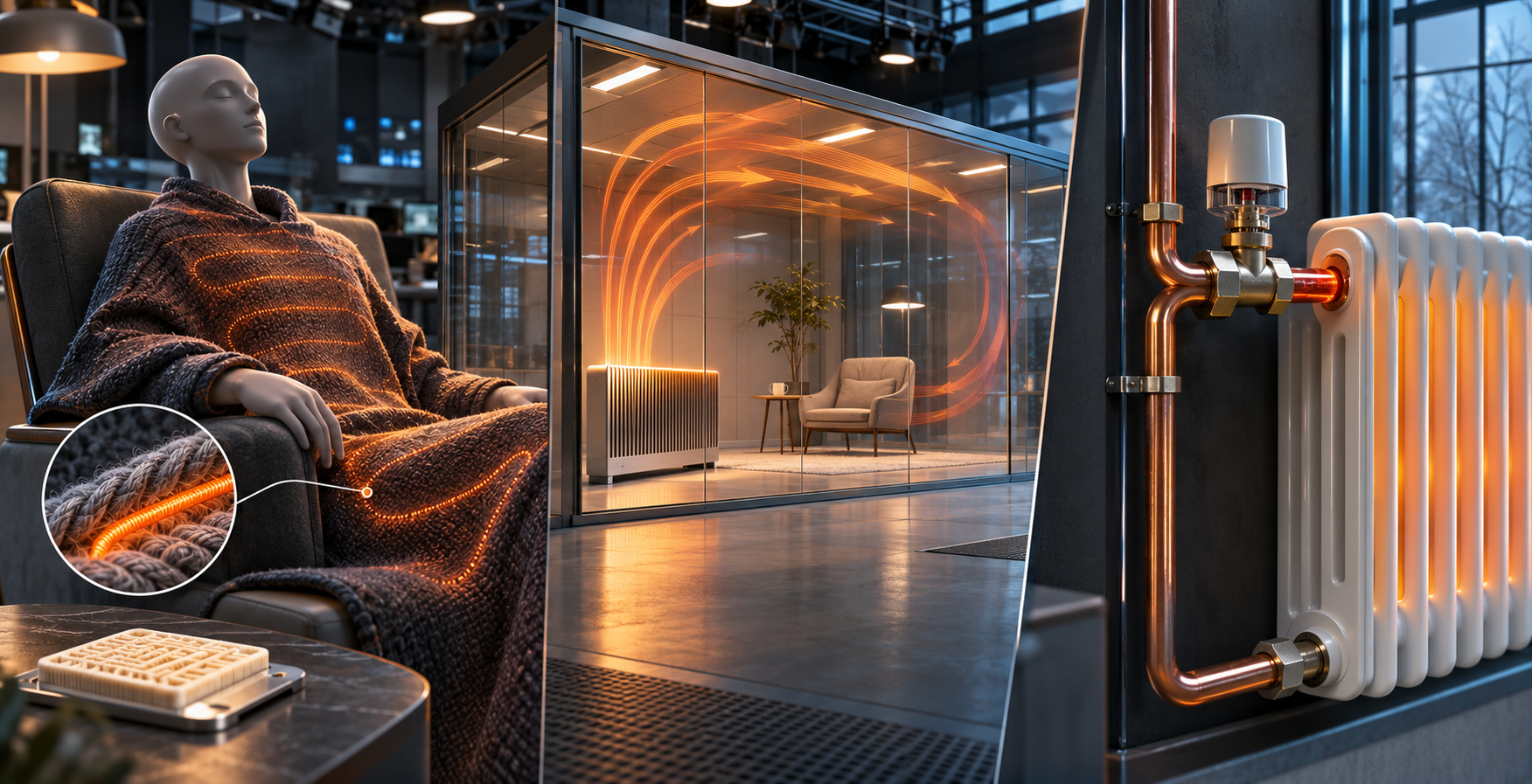
Frandroid’s Black Friday selection groups seven discounted products under a single heating theme, but the devices perform three distinct jobs: warming one person, heating the air in a room, or controlling an existing hot-water radiator. That distinction matters more than the headline reduction when choosing equipment for a small office, reception point or stationary workstation. The source also warns that availability can be limited, so the offer must be checked at the point of purchase.
One promotion covers different heating mechanisms
The products cannot be compared as interchangeable heaters. A heated throw transfers warmth close to its user. A convector heats room air without a fan. A ceramic fan heater moves warm air through a modest space. A connected thermostatic head regulates water flowing through a radiator that is already part of a heating system.
| Product | Mechanism | Relevant workplace task | Main boundary |
|---|---|---|---|
| Duux heated throw | Heated textile around the user | Warming an occupied, stationary position | Does not heat the whole room |
| Dreo 711S | Fanless natural convection | Heating a quiet enclosed room | Uses room-level heating rather than personal warmth |
| Duux Edge | Ceramic fan heating | Raising the temperature in a modest room | The source describes only a modest discount |
| TP-Link Kasa KE100 | Connected valve on a hot-water radiator | Scheduling an existing radiator | Requires a compatible valve and heating system |
This comparison is an operating interpretation of the mechanisms described in Frandroid’s product selection. It is not evidence that any model has been tested in a commercial building.
The heated throw concentrates warmth on one occupied seat
The Duux throw is designed for targeted heating without switching on heating for an entire room. Frandroid lists a size of 200 by 200 centimetres, power consumption of 160 watts, nine power settings, a timer of up to nine hours and overheating protection. Its removable controller allows the textile to be machine washed at 30 degrees Celsius, according to the deal description.
For a commercial operation, the narrow fit is a fixed position occupied for long periods, such as an individual desk or a seated back-office station. The mechanism does not address cold visitors, mobile staff or the ambient temperature across a shared room. The source presents it as a domestic product and provides no workplace cleaning protocol, electrical deployment guidance or evidence from multi-user use.

Conceptual illustration of targeted warmth at a stationary work position.
Room heaters trade personal focus for wider coverage
The Dreo 711S heats air by natural convection rather than using a fan. Dreo claims a sound level of 0 decibels, while the listed specification gives 2,000 watts of power and temperature selection between 5 and 35 degrees Celsius. Frandroid also reports app control, compatibility with Alexa, Google Assistant and Siri, wall mounting, an ECO mode and an IP24 rating that supports bathroom installation. These are reported product specifications, not independent performance measurements.
The Duux Edge follows a different room-heating mechanism. It is a ceramic fan heater intended to warm a modest room quickly, with a slim form designed to sit along a wall or item of furniture. The source describes the reduction as limited, which makes operating fit more decisive than the promotion itself.
Neither description supplies comparative heat-up tests, measured consumption under identical conditions or coverage data for a workplace. The supported choice is therefore between fanless convection and fan-assisted ceramic heating, not a conclusion about which appliance costs less to operate.
The smart valve controls heat that already exists
The TP-Link Kasa KE100 does not generate heat. It replaces the thermostatic head on a hot-water radiator and adjusts that radiator through schedules, the Kasa Smart app or supported voice assistants. The kit includes a KH100 hub connected to mains power and a 2.4 GHz Wi-Fi network; one hub can manage up to 32 radiators. The head uses two alkaline AA batteries with claimed autonomy of more than one year, according to Frandroid’s account.
Its decisive constraint is physical compatibility. The standard connector is M30 by 1.5 millimetres, with adapters supplied, and Frandroid explicitly advises checking the valve before ordering. Window-opening detection additionally requires a Tapo T110 sensor sold separately. The source does not document business administration, access rights or deployment across separate premises.
The purchasing decision is specific: use a heated throw for one occupied seat, a room heater when the surrounding air must be warmed, or the connected valve when an existing hot-water radiator needs scheduling. Check stock and valve compatibility before treating the Black Friday listing as an actionable offer; comparative workplace energy performance remains unknown.
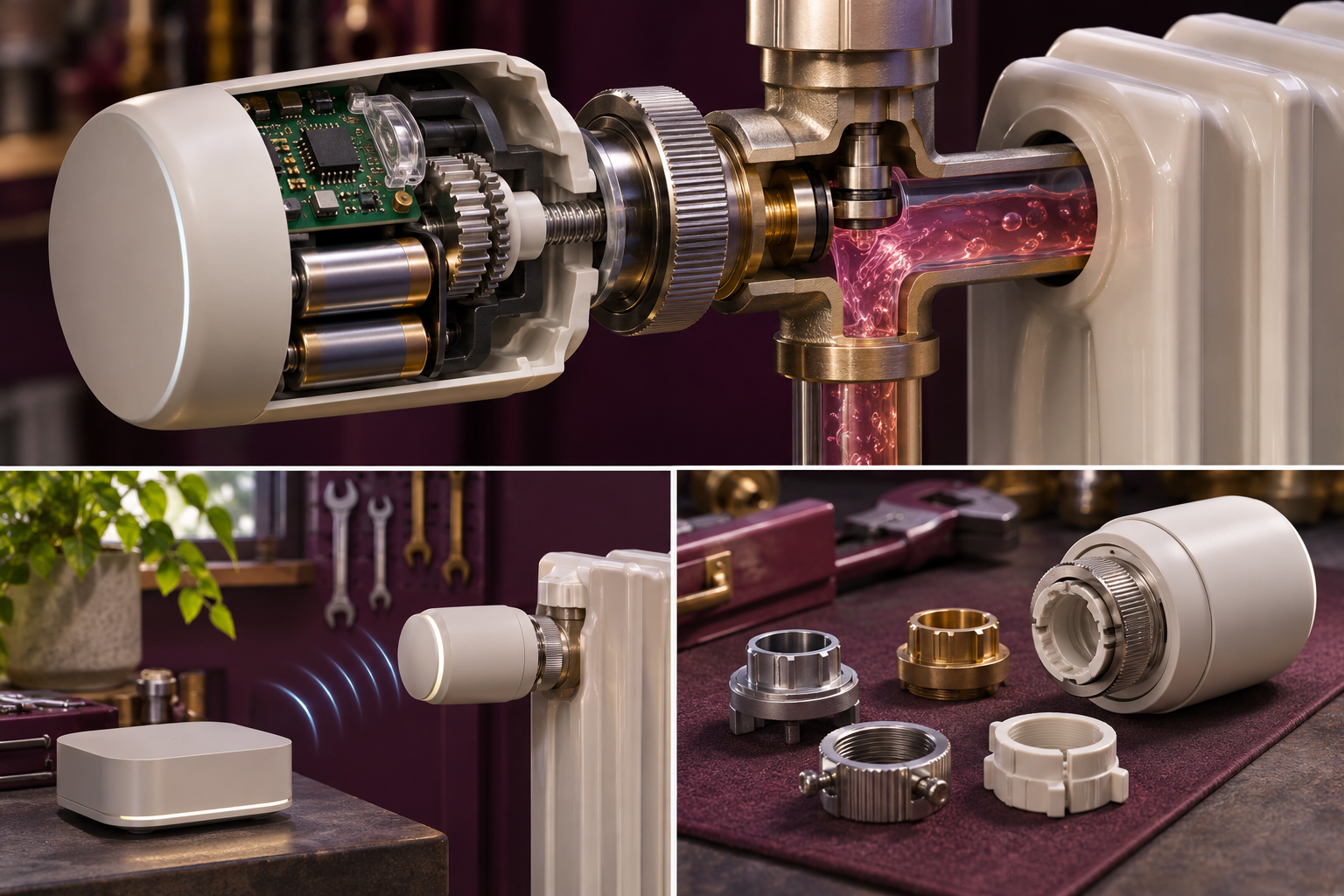
Conceptual illustration of a smart valve controlling an existing hot-water radiator.