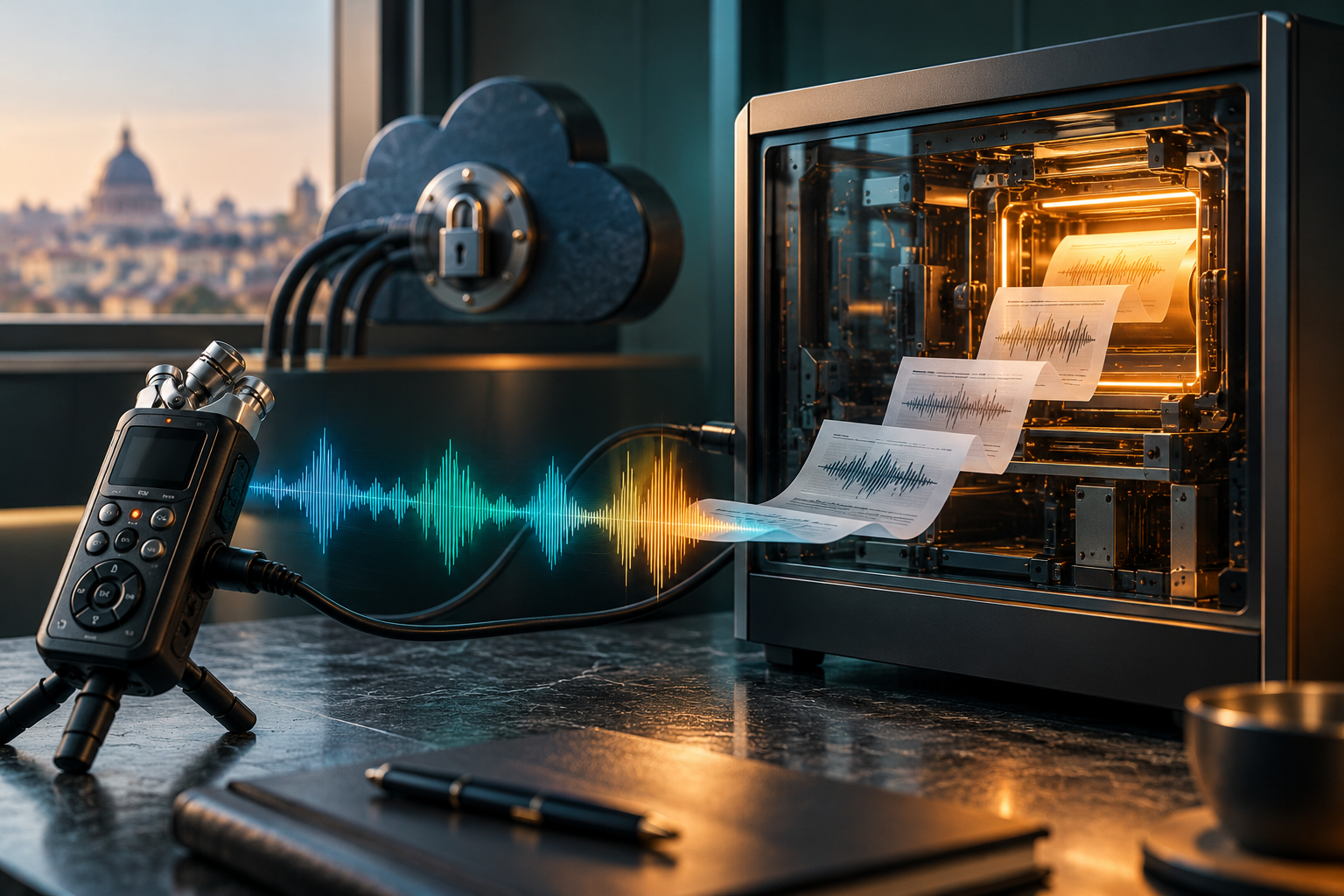
Frandroid’s RTX Spark test processed a seventy-second audio and video sequence with Whisper Large V3 Turbo in six seconds, entirely on the test machine. The transcription handled French and English without an internet connection. The same computer encountered memory errors when the testers combined a language model with an image generator, revealing a sharper boundary than the broad promise of replacing cloud AI. Both results were recorded during the publication’s offline test.
Local transcription is the demonstrated workload
The clearest business use in the test is not a general-purpose chatbot replacement. It is local speech transcription: Whisper Large V3 Turbo converted a seventy-second recording in six seconds and managed French and English in the same test, according to Frandroid’s report.
Automatic speech recognition turns an audio signal into text by processing segments through a model trained to associate speech patterns with written language. In this case, the model and computation were available locally. The task therefore continued without sending a request to a remote AI service during execution.
For a commercial operations team, a hypothetical use would be transcribing a bilingual customer interview while travelling without reliable connectivity. That example follows the demonstrated mechanism, but it is not a result reported by Frandroid. The source tested a recording, not a customer-research workflow or a production deployment.
The report describes processing speed but does not publish a transcript, an accuracy measure or a comparison with a cloud transcription service. It therefore supports the claim that the workload ran quickly and offline on the tested system, not that its output was more accurate than an online alternative.

Conceptual illustration of speech being transcribed locally without a network connection.
The workload stays local because the models are installed
RTX Spark combines an Nvidia GPU with an ARM processor designed by MediaTek. Frandroid installed several open-source language models on the test computer before disconnecting it from the network. The publication reports that local execution required neither a cloud subscription nor purchased usage tokens for those runs, while the computer and downloaded models still had to be available in advance through the tested configuration.
That distinction matters when assessing cost. Avoiding a charge for each cloud request does not make the complete setup costless. Hardware acquisition, storage, preparation and operation remain outside the source’s comparison. Model terms also need to be examined separately rather than inferred from the absence of usage tokens.
Local execution similarly establishes network independence, not complete confidentiality. The test shows that the transcription did not require an internet connection while running. It does not document the operating system, application telemetry, file-retention settings or the model installation process needed to assess the full data path.
Hermes and Flux competed for finite memory
The test became more demanding when Frandroid tried an agentic workflow connecting the Hermes language model with the Flux image generator. On the machine equipped with sixty-four gigabytes of memory, repeated video-memory saturation errors appeared. The testers eventually generated an image after reducing the context size, as described in the same account.
A model’s context is the working material it can consider for a request. Reducing that context lowers the amount of information retained in the active operation. It can free resources, but it also changes the task by narrowing the material available to the model.
The failure does not establish that all local agent workflows exceed the machine’s capacity. It shows that this particular combination, configuration and context reached the available memory boundary. Frandroid argues that a version with one hundred and twenty-eight gigabytes would be necessary for highly complex tasks, but the article does not provide a second test on that configuration to demonstrate the improvement.
This result complements the broader role of unified memory in offline AI: large capacity can allow models to remain close to the processor, yet every concurrently loaded model, context and generated asset still draws from a finite pool.

Conceptual illustration of a multi-model workflow reaching the computer’s shared memory boundary.
Choose the local task before choosing the machine
The source supports two different purchasing signals. Local transcription completed without connectivity and at a reported speed suitable for rapid processing. A combined language-and-image experiment required context reduction after memory errors. Treating both as one category called “offline AI” would hide the operational difference.
Teams evaluating this architecture should first define whether the recurring workload is a single-model task such as transcription or a multi-model sequence that keeps language, context and image generation active together. The tested system provides direct evidence for the former and a documented constraint for the latter.
The decision is therefore narrower than replacing a cloud assistant. RTX Spark is relevant when a specific local workload must continue without a network. For agentic workflows, the unresolved evidence is whether a larger-memory configuration completes the same sequence without reducing context.