Nvidia has launched open-weight agent models for two different operating environments: a large model for enterprise infrastructure and lightweight models intended to run locally on selected PCs and workstations. The release turns model selection into a workload-placement decision rather than a simple comparison of model capability, according to TechCrunch.
That distinction matters for commercial operations teams considering agents for document handling, accounting or other tool-based processes. A centrally hosted model can support shared workloads and larger tasks. A local model places inference closer to an individual worker or device. Nvidia has announced both routes, but the available report does not establish that they deliver equivalent performance or support the same workflows.
One launch covers two deployment tiers
The models differ in scale, intended hardware and stated purpose. Nvidia positions Nemotron 3.5 Super VL as the enterprise tier and Bolt as the lighter local tier.
| Model tier | Intended deployment | Reported role |
|---|---|---|
| Nemotron 3.5 Super VL | Nvidia-based enterprise infrastructure | A 120-billion-parameter open-weight model for agents using instructions and tools, according to TechCrunch |
| Bolt models | AI PCs using RTX Spark and workstations using DGX Spark | Two lightweight models designed for local operation, according to TechCrunch |
Open weights give an organization more control over where a model is hosted than a service available only through a vendor API. They do not, by themselves, specify the software stack, hardware capacity, licensing conditions or integrations required to operate an agent. Those deployment details remain separate from access to the model weights.
Super VL targets workflows that use tools
Nvidia says Super VL can achieve accuracy similar to the larger Nemotron 3 Ultra on instruction-following and tool-use tasks despite using fewer parameters. The company also claims that task-specific post-training enables it to complete selected agent workloads faster than named models from Anthropic and OpenAI, as reported by TechCrunch.
The workloads cited by Nvidia include document intelligence, financial accounting, scientific experimentation, medical insurance claims and resilience against security attacks. These examples identify the intended task classes, not independently verified outcomes. TechCrunch notes that Nvidia supplied a list of organizations it says are using Super VL, including EY, Ramp, CrowdStrike, Perplexity, Salesforce and Skydance, but the report does not provide customer results or comparable production measurements.
For a commercial operations team, document intelligence is the clearest use case in the announcement. A model could be evaluated within a bounded process that receives documents, extracts required information and invokes an approved downstream tool. The release supports evaluating that architecture; it does not establish extraction accuracy, exception rates or the effort needed to connect existing systems.

Conceptual illustration of a tool-using document workflow, not a photograph of the Nvidia model.
Bolt brings the runtime closer to the worker
The Bolt models address a different constraint: running an agent locally on supported hardware. Nvidia intends them for new AI PCs using RTX Spark and for DGX Spark workstations. TechCrunch reports that suitable PCs are entering the market through partners including Microsoft and Dell and are aimed at consumers, programmers and enterprise knowledge workers (source).
Local execution changes where model inference occurs, but it does not guarantee that an entire workflow remains on the device. An agent can still call remote applications, retrieve external material or send output to a hosted system. Teams therefore need to distinguish the location of the model from the location of its tools and data.
A model also needs a control surface before it can act on software. That is a separate layer from this launch, illustrated by NVIDIA App’s local agent control interface. The new models provide an inference component; the TechCrunch report does not describe a complete agent runtime, its permissions or the application connectors bundled with Bolt.
The report also supplies no memory requirements, device-level performance results or workload comparisons for the lightweight models. Without those details, buyers cannot determine from the announcement alone which existing PCs qualify or how much work a local agent can sustain.

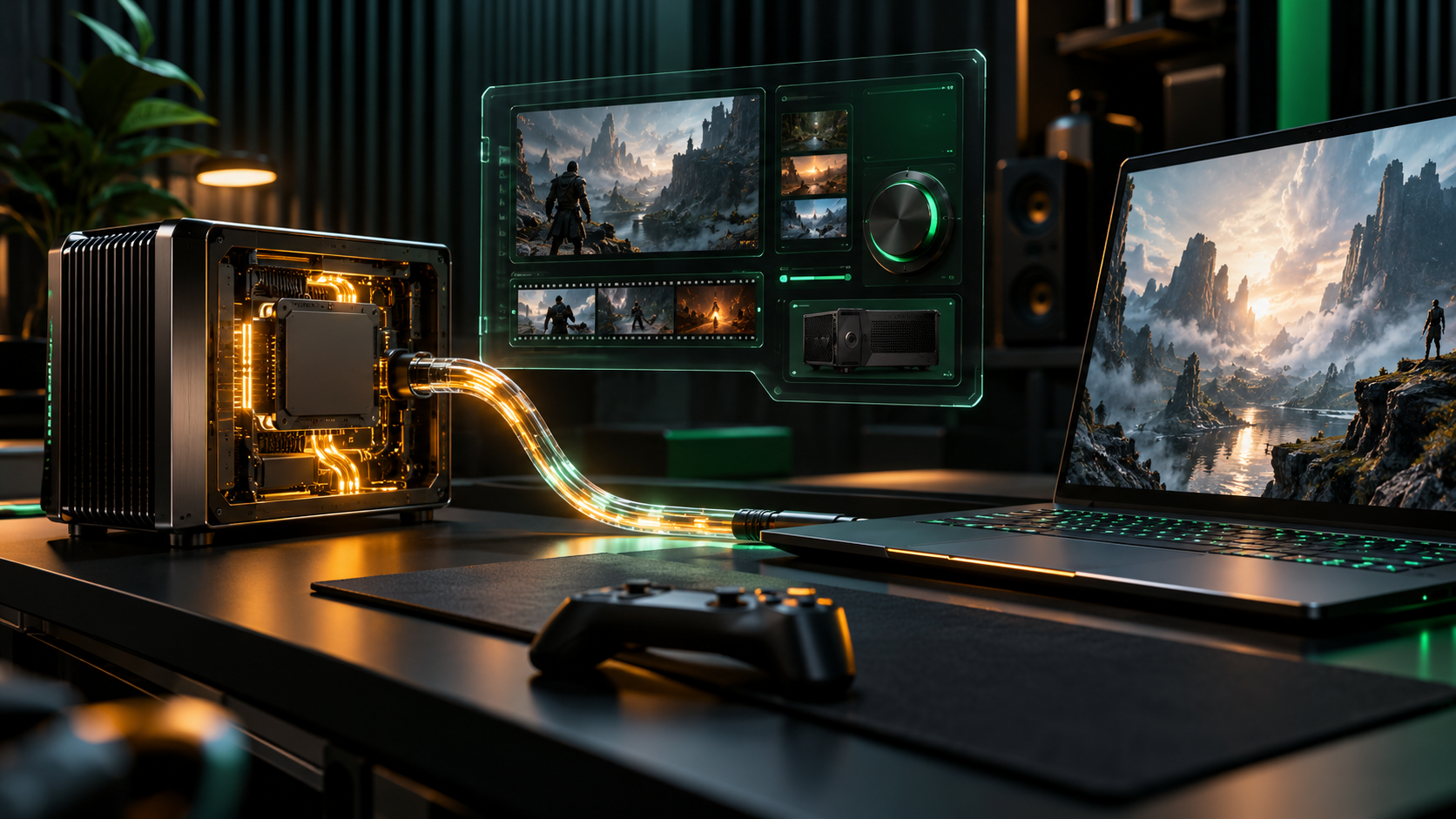
Conceptual illustration of local inference and separate tool connections, not a photograph of an Nvidia device.
Choose the task location before the model
For shared document or accounting processes that require a larger model and centrally managed tools, Super VL is Nvidia’s stated fit. For a bounded task that must execute on a supported worker device, Bolt represents the local route. The announcement does not show that one tier can replace the other.
The immediate decision is therefore where a defined agent workload should run and which tools it must reach. Super VL and Bolt provide new open-weight options for those two locations. The evidence still needed is operational: hardware requirements, integration details and measured results on the organization’s actual task.