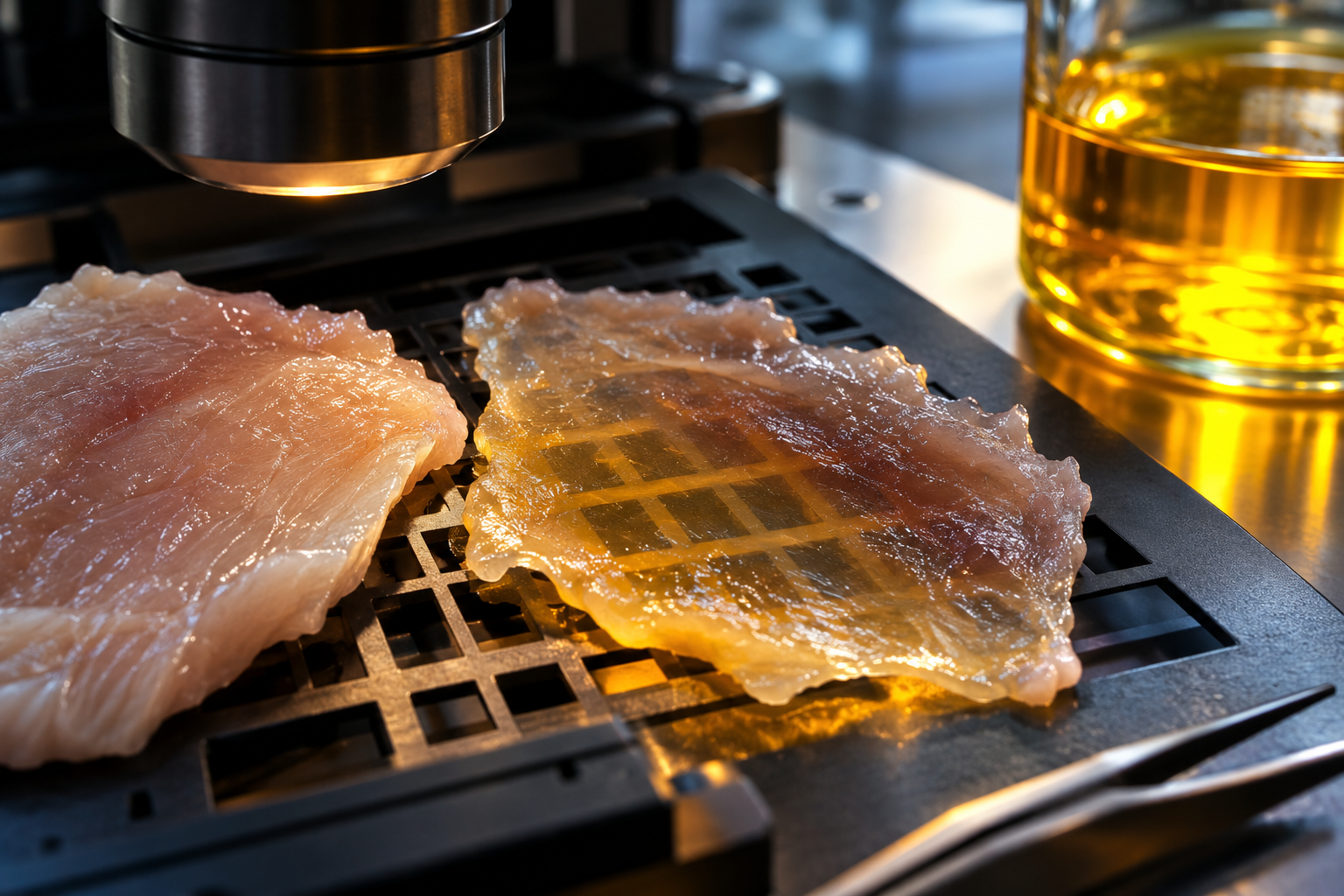
A thin raw chicken-breast sample became partly transparent after soaking in a tartrazine solution. Background grid lines remained visible through part of the tissue, giving the sample a translucent, gummy-like appearance, according to the researcher’s published account of the experiment.
Despite the headline reference to “Dorito dust,” the experiment used tartrazine supplied by APC Pure rather than crushed snack seasoning. The material contained more than 80 percent dye, which the researcher identifies as a source of uncertainty in the true concentration of the prepared solution, as detailed in the same experimental record.
The result is partial, not a full replication
The warm-up test used a sample approximately two millimetres thick, cut from a five-millimetre slice. It was soaked in a solution of about 0.19 molar tartrazine for six hours at room temperature. The researcher reports that the published protocol being followed used 0.62 molar tartrazine, a temperature of 40 degrees Celsius and mechanical shaking.
Those differences matter because concentration, temperature and agitation were all changed together. The experiment therefore demonstrates that visible translucency appeared under the modified conditions, not that the original result was reproduced under its specified protocol. The author explicitly describes the outcome as partial transparency and the exercise as preparation for a more ambitious replication in the experiment notes.
A water-soaked control was placed beside the treated sample. Although dye contamination left that control slightly yellow, the comparison helps separate coloration from the area where the underlying grid became visible. It does not isolate which protocol variable produced the difference.
Tartrazine changes the optical relationship inside tissue
The researcher’s working explanation concerns refractive-index matching. In the account, tartrazine absorption is described as shifting the refractive index of water towards that of the tissue’s protein and lipid components. When those optical properties become more closely aligned, light can pass through the material with less of the redirection that normally obscures objects behind it.
This mechanism also explains why transparency is not the same as physical dissolution. The treated sample retained the same texture to the touch even though its visual appearance changed, according to the researcher’s observation. The result concerns how light travels through the sample, not a reported loss of its structure.
The post presents that mechanism as a current model rather than a measurement from this warm-up test. It does not report direct refractive-index measurements or establish how evenly the dye entered the tissue. The visible grid is evidence of an optical change, but it does not by itself validate every step in the proposed explanation.
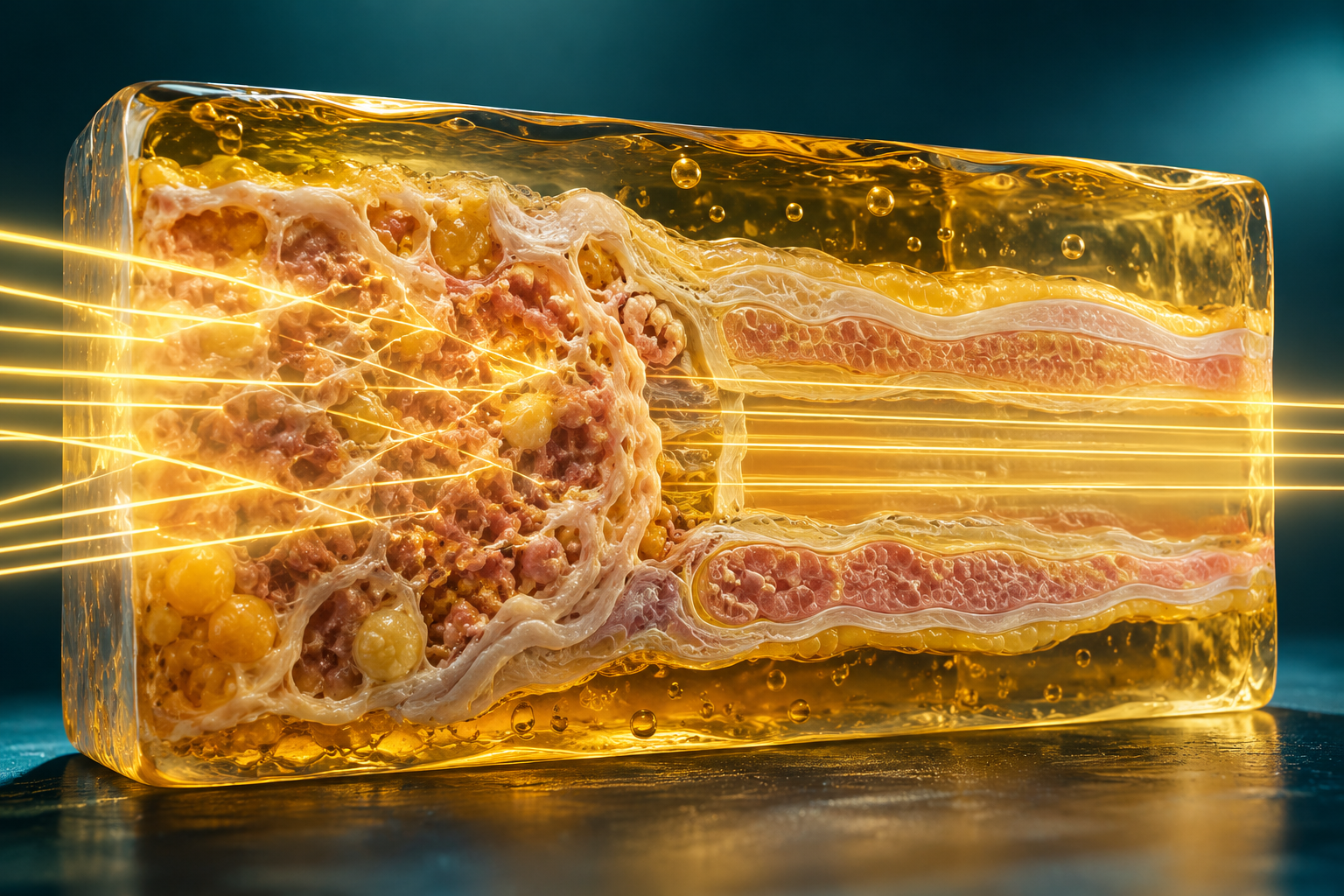
Conceptual illustration, not a photograph, of the refractive-index matching mechanism proposed in the experiment.
The evidence supports a demonstration, not a method
For teams assessing a striking technical demonstration, the useful distinction is between observing an effect, replicating a protocol and establishing a usable process.
| Decision category | What this experiment establishes |
|---|---|
| Visual demonstration | A treated chicken sample showed local transparency over a background grid. |
| Protocol replication | Not established because the concentration, temperature and agitation differed from the cited procedure. |
| Repeatable operating method | Not established because the post reports a warm-up attempt rather than repeated runs under fixed conditions. |
The first category is enough for communicating the phenomenon accurately. The second requires matching or deliberately varying the relevant conditions so that differences can be attributed. The final category would require evidence beyond the post, including repeatability and a clearly defined application.
This distinction applies directly when commercial teams encounter product demonstrations with a compelling visual outcome. A demonstration answers whether something happened in one documented setup. It does not automatically answer whether the mechanism is fully verified, whether the process transfers to another environment or whether it is ready for operational use.
A closer replication is the evidence to watch
The next informative result is a controlled attempt using conditions closer to the cited protocol, followed by comparisons that change one relevant condition at a time. The researcher says such a replication is being developed, but the current publication contains only the preliminary chicken-tissue test.
Until that work is published, the defensible conclusion remains narrow: laboratory tartrazine produced partial optical transparency in this sample under altered conditions. The post does not establish a standard process, a commercial application or performance beyond the photographed specimen.
The decision is therefore not whether to accept or dismiss the visible effect. It is whether the intended use needs only a demonstration of the phenomenon or evidence of a controlled, repeatable method. For any operational decision, waiting for the closer replication preserves that distinction.

Conceptual illustration, not a photograph, comparing the warm-up setup with the more controlled protocol described by the researcher.